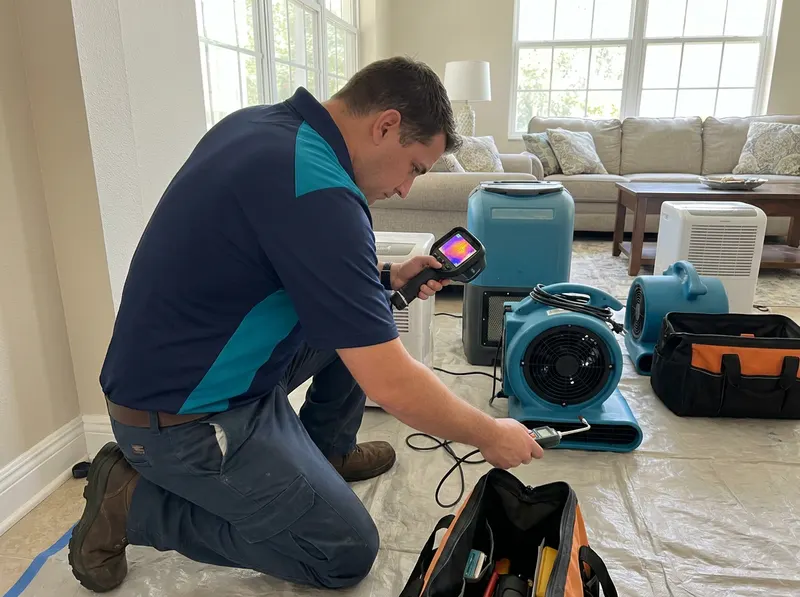
Two Tampa conditions make moisture inspection different from most cities. First, the region's average relative humidity runs above 70% through the summer, which keeps wet building materials from drying on their own, a wall that would air-dry in a drier climate stays saturated here. Second, many homes in Seminole Heights, Hyde Park, and the older bungalow blocks near Bayshore Boulevard sit on wood subfloors or pier-and-beam foundations, where standing water wicks into joists and stays hidden under finished flooring. A moisture meter reads material saturation directly; dry drywall reads under about 1% moisture content, while wet drywall reads far higher, and readings above the local dry standard flag the spots that need attention.
A thermal camera does not detect mold or water itself, it detects temperature differences, and evaporating water cools a wall surface, which shows the wet outline behind paint. This matters in Tampa slab-foundation neighborhoods like Carrollwood and Westchase, where a slow supply-line leak spreads under tile with no visible stain for days. Inspection also covers the places tied to local weather: attic decking after wind-driven rain, the base of exterior walls after Gulf storm surge in coastal areas like Davis Islands, and the drain pans on air handlers, which overflow often in summer when condensate lines clog.
A typical inspection follows four steps. First, ambient temperature and humidity are recorded in each room. Second, moisture-meter readings are taken on suspect surfaces and compared against a dry reference wall in the same structure. Third, a thermal scan maps the boundary of the wet zone. Fourth, findings are written into a moisture map noting which materials read above the dry standard. If everything reads dry, the visit ends there with documentation. If materials read wet, that documentation becomes the scope for a drying or removal job.
The decision between a simple inspection and full drying depends on how long the water has been present and how much material is affected. If a single room got wet within the last day and readings are only slightly elevated, an inspection plus targeted air movers usually resolves it. If subfloor or wall cavities have been wet for several days, or readings stay high across multiple rooms, controlled drying with dehumidifiers and containment is the fit, the trade-off is a longer, costlier project versus the risk of colonies spreading through framing. A moisture inspection is not mold testing: it measures water in materials, while a certified mold assessment (a separate service under Florida licensing) samples air and surfaces to identify species. Confirming actual mold requires that assessment, not a moisture reading.