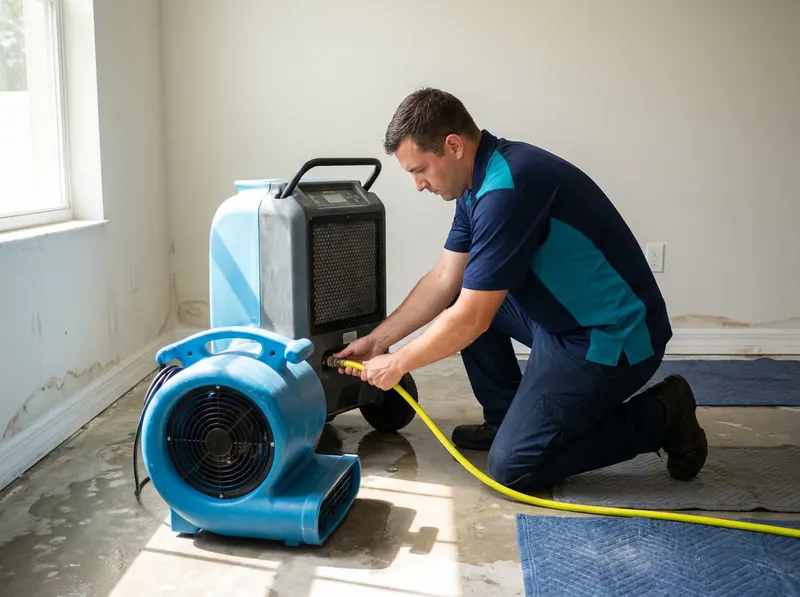
Structural drying targets the water you cannot see. After extraction pulls standing water, moisture stays locked inside wall cavities, under laminate, and in the slab, and in Tampa's average 74% relative humidity, that trapped water feeds mold if it is left to air-dry on its own. Air movers create high-velocity airflow across wet surfaces to push moisture into the air, and dehumidifiers then pull that moisture out of the room. A low-grain-refrigerant (LGR) dehumidifier removes water down to lower humidity levels than a standard unit, which matters in older South Tampa and Hyde Park bungalows where plaster and original heart-pine floors hold water longer than modern drywall.
Equipment count is set by the affected area, not a flat guess. The industry reference standard, ANSI/IICRC S500, sizes air movers roughly one per 10-16 linear feet of wet wall and one dehumidifier per calculated cubic-foot load. A flooded 12x12 bedroom in Carrollwood might run 3-4 air movers and one LGR dehumidifier; a saturated ground floor in a Davis Islands two-story can require 8-12 air movers and multiple dehumidifiers. Moisture readings are logged daily so drying progress is measured against a dry standard rather than assumed.
Deciding between drying in place and removal comes down to the material and how long it sat wet. If drywall was wet for under 48 hours and reads only moderately high, drying in place with equipment usually saves the wall; if the water was contaminated (a sewage backup or a storm-surge event common near Bayshore Boulevard and the Westshore flats) or the drywall stayed wet for days, removal is the safer path because porous material cannot be reliably decontaminated by drying alone. Hardwood floors are a middle case: cupped Tampa oak can sometimes be dried flat with floor mat systems over 7-10 days, but boards that have crowned or buckled often need replacement.
How the process runs: 1) Extraction and material inspection with a moisture meter and thermal camera. 2) Equipment placement sized to the wet area. 3) Daily monitoring visits to record moisture levels and reposition units. 4) Equipment removal once framing reaches its dry standard. 5) Clearance readings that document the space is dry before any rebuild begins. A structural drying job is not the same as mold remediation, drying prevents mold; if colonies have already formed, that is a separate containment-and-removal service.