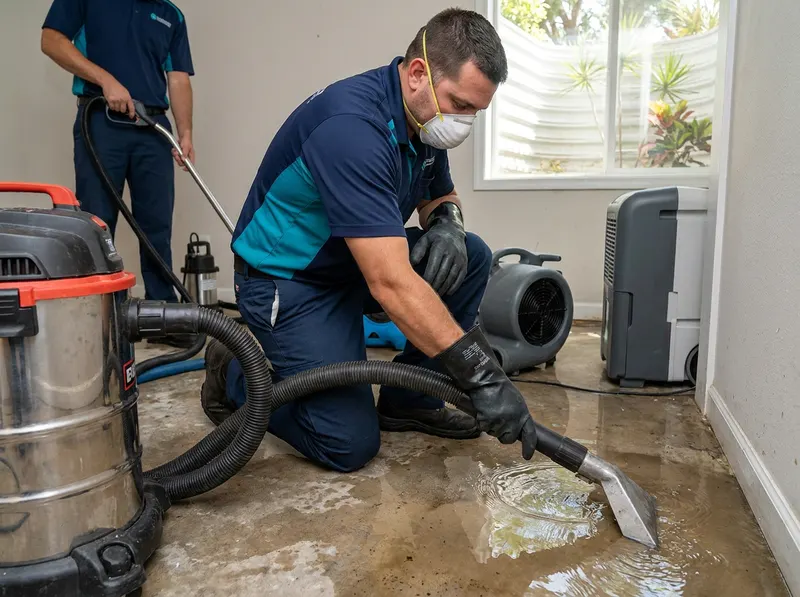
Category 3 water requires different handling than a clean-water pipe leak. A supply-line break is Category 1 water that can often be dried in place; a sewage backup or storm-surge intrusion is Category 3, where the IICRC S500 standard directs removal of any porous material below the contamination line. That single distinction drives most of the scope and cost. Technicians typically wear a respirator, nitrile gloves, and full-body suits, and set up a containment barrier so airborne contaminants do not spread to unaffected rooms.
The work follows a set sequence. First, standing water is extracted with a truck-mount or portable unit. Second, contaminated porous materials, carpet, pad, drywall cut roughly 12, 24 inches above the waterline, and soaked insulation, are bagged and hauled out. Third, every remaining surface is HEPA-vacuumed and treated with an EPA-registered antimicrobial. Fourth, air movers and dehumidifiers run for 3, 5 days while a technician logs moisture readings with a meter until framing reaches the region's normal 12, 15% wood moisture content. Fifth, a final wipe-down and clearance check confirm the area reads clean before rebuild begins.
Tampa geography raises the odds of Category 3 events. Older neighborhoods like Seminole Heights and Tampa Heights sit on clay-tile sewer laterals from the 1920s, 1950s that crack and root-clog, sending backups up floor drains. Low-lying areas near the Hillsborough River, Palma Ceia, and South Tampa flood during summer downpours and named storms, pushing storm water, treated as contaminated once it crosses the ground and mixes with sewage, into ground-floor slabs. Homes on septic systems in unincorporated Hillsborough County near Riverview and Brandon can back up when the drain field saturates during the June, September wet season.
Decision guidance is straightforward. If water is clear and from a clean source like a supply line, standard water extraction and in-place drying usually apply. If the water came from a toilet trap, a sewer main, a septic field, or ground-level flooding, treat it as Category 3, the affected porous materials come out and the space is sanitized, not merely dried. A single contaminated bathroom is a smaller scope; a slab-wide backup across a South Tampa bungalow with hardwood and cabinetry is larger and takes longer to clear. Attempting to dry sewage-touched drywall in place is the common misunderstanding that leads to mold and a second, costlier remediation weeks later.